When a root canal fails, you generally have two paths: non-surgical retreatment or a surgical apicoectomy. Neither is universally better — the right choice depends on why the original treatment failed, how long ago it was placed, and what's currently sitting on top of that tooth.
The Failure Timeline: What the Age of Your Root Canal Tells You
Most patients don't know that the timing of a root canal failure is one of the most revealing diagnostic clues available. For Encino-area patients, understanding this timeline is the first step toward saving a tooth.
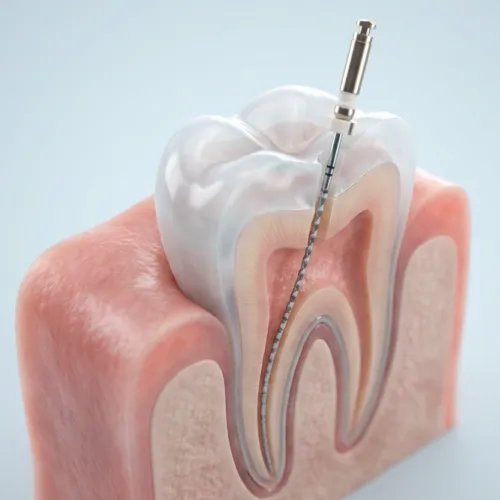
If a root canal fails within one to two years of placement, the cause is usually coronal — meaning something went wrong during the original procedure itself. A canal may have been missed, the seal may have been inadequate, or bacteria found a pathway back in before a permanent crown was placed. These are problems a skilled endodontist can often correct non-surgically. According to the AAE, retreatment involves reopening the tooth, removing existing filling material, searching for additional canals or new infection, and resealing everything with fresh material.
When a root canal fails five, eight, or ten years later, the story changes. Long-term failures are more often rooted in microscopic anatomy at the very tip of the root — apical ramifications, tiny branching canals, or calcified areas that instruments simply cannot reach from above. In these cases, retreatment may clean the main canal perfectly and still leave the actual source of infection untouched. An apicoectomy, which accesses the root tip directly through the gum tissue, becomes the only way to address the problem without extracting the tooth.
Research published via NIH found that non-surgical retreatment showed a complete healing rate of 76.7%, while apicoectomy demonstrated cumulative tooth survival rates above 81% at three years. Neither approach is superior across the board — the failure pattern guides the decision.
The Crown-Preservation Factor: Why Your Existing Restoration Matters
Here's a detail most patients never consider until they're already in the chair: non-surgical retreatment requires drilling through your existing crown and any post that may be cemented inside the root.
If you have a well-fitting crown in good condition, retreatment puts that restoration at real risk. Drilling through porcelain can cause fractures. Removing a post that has been cemented for years can stress the remaining tooth structure. In some cases, the crown cannot be reused afterward and must be remade entirely.
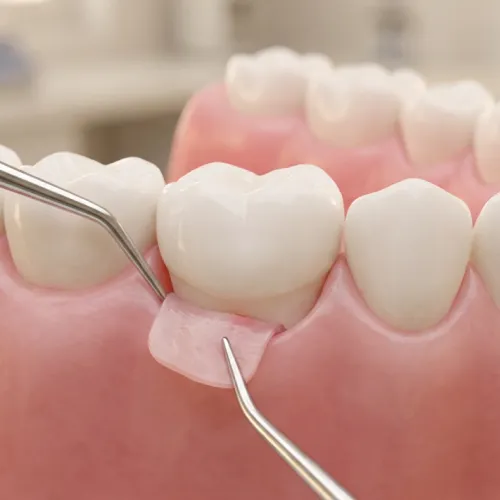
An apicoectomy sidesteps this entirely. The surgeon accesses the root tip by making a small incision in the gum tissue below the tooth — the crown is never touched. As Healthline explains, only a few millimeters of the root tip are removed, the canal is sealed from below, and sutures close the gum tissue. The restoration above stays completely intact.
For patients with a relatively new or structurally complex crown, this factor alone can tip the decision toward surgery. Your endodontist will evaluate the existing restoration as part of the full treatment plan. If you'd like to understand more about the cost of root canal treatment before moving forward, that context can also help inform your decision.
Location-Specific Surgical Risks: Sinus and Nerve Anatomy
Generic comparisons of these two procedures rarely explain that apicoectomy risks are not uniform — they vary significantly based on which tooth needs treatment.
For upper back teeth, the roots sit close to the maxillary sinus. A surgical approach carries a real risk of sinus perforation, which can lead to sinus infections or require additional management. For lower premolars and molars, the mental nerve and inferior alveolar nerve run nearby. Disturbing either can cause temporary — or in rare cases permanent — numbness in the lip, chin, or cheek.
Non-surgical retreatment carries none of these anatomical risks because no incision is made and no bone is disturbed.
This is why a 3D cone beam CT scan is so valuable before any decision is finalized. It maps the exact position of the root tip relative to the sinus floor or nerve canal, giving your specialist the data needed to determine whether surgery is actually safe for your specific anatomy. Our dental technology allows these boundaries to be assessed with precision before any procedure begins, as the AAE also notes regarding advanced digital imaging.
A root canal that looks like a clean apicoectomy candidate on a flat X-ray may look very different on a 3D image. Location matters enormously.
Weighing the Evidence and Making the Call
Both options have strong track records. A systematic review summarized by the AAE Newsroom reinforces that retreatment can preserve teeth long-term when the failure has a correctable cause. Research comparing the two approaches consistently finds no statistically significant superiority of either method in long-term follow-up — meaning patient-specific factors carry the most weight.
The decision ultimately comes down to four questions your endodontist will work through with you:
- How long ago did the original root canal fail?
- What does the existing restoration look like, and can it withstand retreatment?
- Where is the root tip in relation to the sinus or nerve?
- What does the 3D imaging reveal about the source of infection?
Extraction should remain a last resort. Either of these paths, when chosen correctly, gives your natural tooth a strong chance at a full recovery. In cases where a tooth cannot be saved, understanding your options for dental implants can help you plan ahead.
See an Endodontic Specialist in Encino
If you've been told your root canal has failed, the next step is a thorough evaluation — not a rushed decision. Akemi Dental Specialists serves patients throughout Encino and the San Fernando Valley with advanced endodontic diagnostics, including 3D imaging, to help you understand exactly which path is right for your tooth. Dr. Matthew Okui and our team are ready to guide you through your options. Contact our office to schedule your consultation.
This article is for informational purposes only and does not constitute medical or dental advice. Always consult a licensed dental professional for diagnosis and treatment recommendations specific to your situation.