Is Root Canal Retreatment Worth It to Save Your Natural Tooth?
Wondering if root canal retreatment can save your tooth? Learn about success rates, lifespan, and benefits. Contact Akemi Dental Specialists today!
Read More


Emergency Dentistry
If you have ever noticed bleeding when you brush, persistent bad breath, or gums that look a little puffier than usual, it is easy to shrug it off and hope it goes away. The tricky thing about gum disease is that it often does seem to “come and go” at first. That is part of what makes it so easy to ignore.
Here is the more helpful way to think about it: gum disease is not a sudden event. It is a slow shift in the health of the tissues that support your teeth, and it usually starts quietly. The earlier you understand what is happening, the easier it is to stop it before it causes permanent damage.
This article breaks down gum disease in a way that actually makes sense, so you can spot the early signs, understand the progression, and know when it is time to come in for a professional assessment at Akemi Dental Specialists.
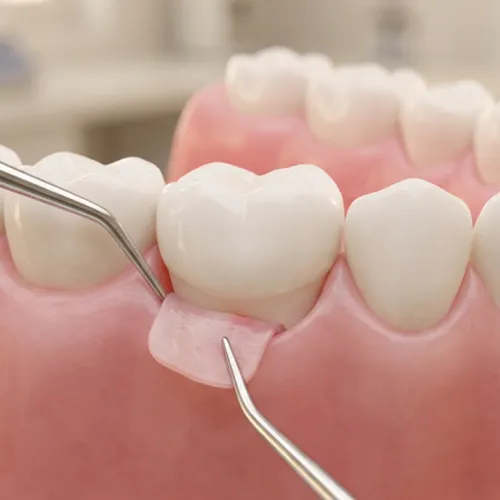
Your gums are not just “pink skin.” They are a living barrier that seals around each tooth. When plaque and bacteria sit along the gumline long enough, your body responds with inflammation. If that inflammation stays unresolved, the seal loosens, deeper bacteria move in, and the supporting structures, including bone, can begin to break down.
Gum disease generally moves through two main stages:
Some symptoms are obvious. Others are easy to miss or explain away.
Signs you might notice:
Signs that can sneak up on you:
One important point: pain is not a reliable early warning sign. Many people have active gum disease with very little discomfort.
Even if your teeth look clean, there is a whole ecosystem living at the gumline. When plaque is not removed thoroughly, it hardens into tartar (calculus), and bacteria become harder to disrupt with brushing alone.
Here is what is happening under the surface:
Think of it like this: early gum disease is not just “dirty gums.” It is your body being stuck in an inflammatory cycle. Over time, that cycle starts affecting the structures that hold teeth in place.
Why bleeding matters: Bleeding is often the first visible sign that the gum tissue is irritated and inflamed. It is not simply “brushing too hard.” In many cases, it is your gums saying, “I am not healthy right now.”
Gingivitis is the early stage, and it is the stage where we have the best chance of a full reset with good home care plus professional cleaning.
Gingivitis becomes periodontitis when inflammation becomes ongoing and deeper bacteria take hold. At that point, the issue is no longer only at the gum surface. It involves the attachment structures underneath.
Here is the progression in a practical way:
Why this matters: periodontitis is not just “worse gingivitis.” It is a different stage where bone support can be lost, and lost bone does not simply grow back on its own.
Risk factors that can speed up the shift from gingivitis to periodontitis include:
None of these mean gum disease is inevitable. They simply mean you may need a more proactive plan.
Yes, and this is one of the biggest misunderstandings about gum disease.
Bone loss can begin quietly, especially if:
Also, gum disease is not always dramatic in the early stages. You might only notice:
How do we detect early bone loss and periodontitis?
At Akemi Dental Specialists, we look at several clues together:
This is why waiting for “serious symptoms” can backfire. By the time teeth feel loose, the disease is often advanced.
Home care matters, but it has to be the right home care. The goal is to disrupt plaque at the gumline consistently.
Focus on these habits:
A simple checkpoint: If you have bleeding when brushing or flossing for more than a week, that is not something to ignore. It is a reason to get evaluated.
Gum disease treatment is not about “scraping harder.” It is about removing what you cannot fully remove at home and reducing the bacterial load below the gumline.
Depending on what we find, treatment may include:
The goal is to stop progression, reduce inflammation, and help you keep your natural teeth healthy for the long term.
You do not need to wait for a crisis. In fact, gum disease is one of those problems that is easier and less expensive to address early.
Consider booking an evaluation if you have:
If you suspect gum disease, schedule an appointment with Akemi Dental Specialists. We will evaluate your gum health, measure pockets, review X-rays if needed, and walk you through a clear plan to get things back on track before bone loss becomes the headline of your story.

Dental Specialists Encino, CA
Here's what our patients are saying about us...





Mon, Fri 6:30 am - 4 pm
Tue, Thu 6:30 am - 5 pm
Wed 6:30 am - 3 pm
Sat, Sun Closed
16055 Ventura Blvd. Suite #820, Encino, CA 91436

Endodontic Care Encino, CA